Showing posts with label Cardiovascular/Blood. Show all posts
Showing posts with label Cardiovascular/Blood. Show all posts
Saturday, April 30, 2011
Objective 2: Pimples
One day in class during lecture Mrs. Gess was talking about blood and how the white blood cells help in defending our body against infection. Well as we were talking she said something about the macrophages, well macrophages when they die turn into pus. Now every time I see a pimple I think about popping it to see the dead macrophages.
Objective 2: Everywhere I Go I See Anatomy & Physiology
In class Mrs.Gess always seems to be going back to the topic of sludgy blood. Every system can contribute to sludgy blood. All the term slugdy blood refers to is just that, our blood is thick and sludgy. When things dont make it out of our system and stay and get caught up in our blood our blood becomes sludgy. And hello, sludgy blood isn't good for our bodies. The sludgier our blood becomes, the hard it is for it to travel through our vessels, therefor increaseing our blood pressure, and no needs to have high blood pressure. There are many different things that can cause our blood to become sludgy: antigens aka bad guys, too much oxygen or carbon dioxide, differnet waste materials, and even too much water in our blood.
Wednesday, April 13, 2011
Objective 17: What Does Blood Do????
Okay so what is bloods job?
#1.Shipping
Takes oxygen from lungs to all places in body
Transports nutrients from intestines to the cells in body
Gets rid of waste
Carrys hormones to their specific organs
#2.Maintenance
It helps keep our body's the right temperature
Keeps our pH in order
Controls fluid levels in the circulatory system
#3.Security
Fights off bad guys
Loss prevention, helps keep the blood in the vessels
#1.Shipping
Takes oxygen from lungs to all places in body
Transports nutrients from intestines to the cells in body
Gets rid of waste
Carrys hormones to their specific organs
#2.Maintenance
It helps keep our body's the right temperature
Keeps our pH in order
Controls fluid levels in the circulatory system
#3.Security
Fights off bad guys
Loss prevention, helps keep the blood in the vessels
Tuesday, April 12, 2011
Objective 18:What's Blood Like??????
Ewwwwwweee, it's sticky, yes our blood is sticky and thick. It can be super bright red to a dull dark red. It is thicker than water mostly because of the formed element that are found in blood. It almost has the perfect neutral pH score, bloods pH level lies somewhere between 7.35 and 7.45. Males have about 5-6 liters of blood flowing through them where as women have only about 4-5 liters flowing through them. But wow that's not a lot of blood if you think about it, that's like between 2-3 of the 2liters of coke being pumped through our bodies, that is crazy I can drink about 3 of the 2 liters in like a week. WOOWWWW!!!!!!!


Monday, April 11, 2011
Ojective 19: Whats Blood Made Of ???
So blood isn't just blood, well I mean yea it is but not like I use to think it was. Now I see that it's not just this red liquidy stuff that comes out of me when I cut myself. Blood is made up of all this different stuff. 55% of blood is made of this stuff called plasma which is said to look straw clolored. Then there are the red blood cells which make up 45% of the blood. Then between the two, there is a layer called the buffy coat and it only takes up less than 1% of the blood.


Sunday, April 10, 2011
Objective 20:"Look out she's comming through"
Mrs. Guess asked all of the students to step out into the hall and line up into two lines side by side. Her analogy was that she was a red blood cell traveling through the capillaries in our body's. As she was pushing her way through all of us she was bumped around a great deal, which represented how the red blood cells are pushed through the blood and how their outer layers get ripped off. Because red blood cells have no nucleus they are not able to reproduce or repair themselves. That is why they have such a short life span of only 100-120 days. Red blood cells carry the the oxygen and carbon dioxide in the blood. In pictures the look like little doughnuts. There are about 4 to 6 million red blood cells found in the blood


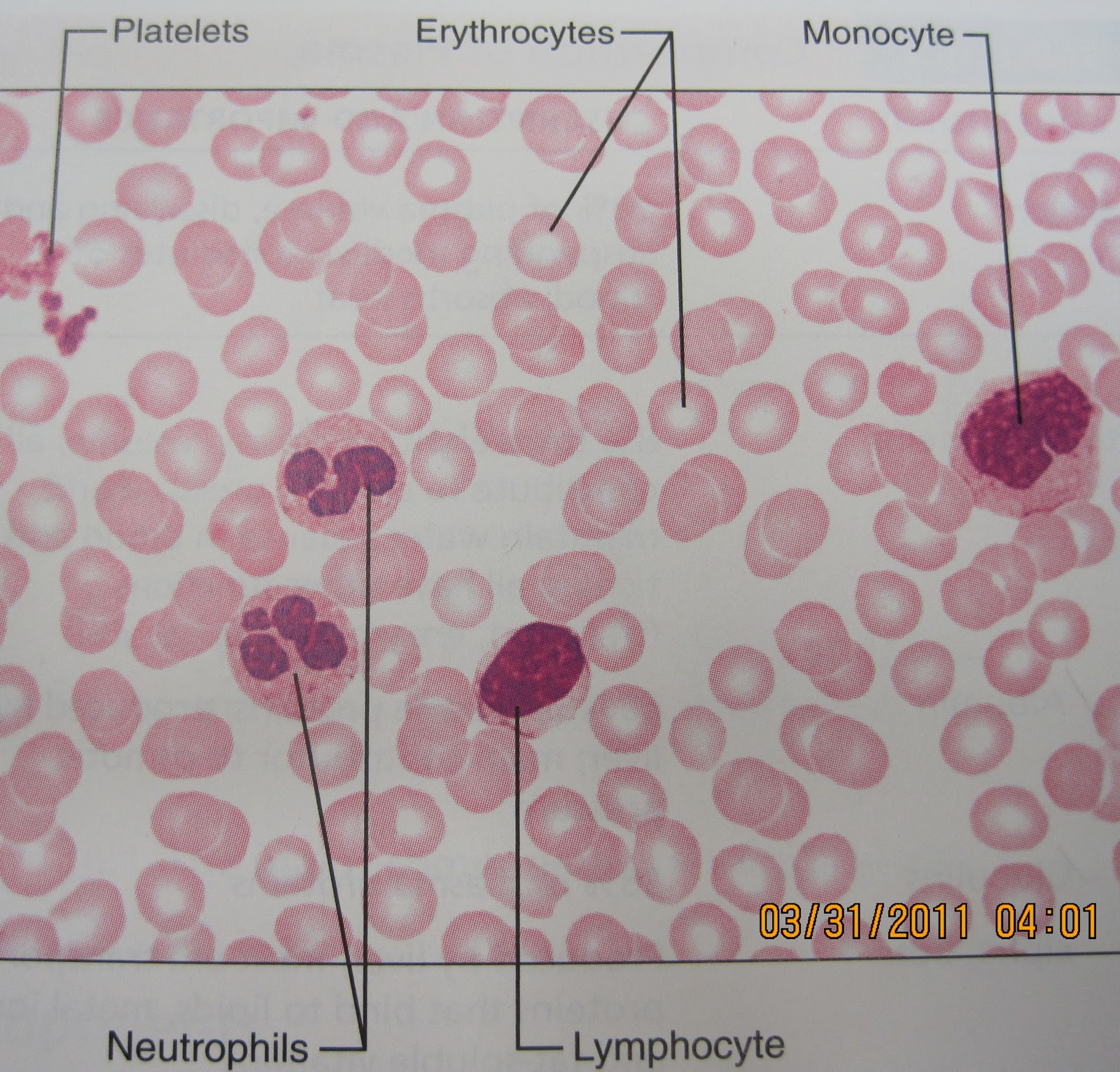
There are five different types of leukocytes:
Neutrophils:have multi lobes, and eat up bacteria, about 3000-7000 cells found in body, live anywhere from 6 hours to a few day. About 3000-7000 are found in our bodies.
Eosinophils:bi-lobed, kill bad worms, help with allergies and asthma, about 100 - 400 cells found in body,live approximately 5 days. 100-400 of these take up space in our blood.
Basophil:is also bi-lobed, these poor guys only live a few hours to maybe a few days, their job is to release histamine and other hormones that help with inflammation. These are only about 20-50 of these guys in our blood.
Neutrophils, Eosinophils, and Basophils are all Granulocytes.
Agranulocyes include Lymphocytes and Monocytes.
Lymphocytes: are spherical shaped, they attack the bad guys cell to cell or by antibodies, they can live for hours or for years. About 1500-3000 can be found circulating through our bodies.
Monocytes: have a U shaped structure they live for only a few months, their job is to eat up the bad guy. There are about 100-700 of these cells found in the body.
Like always under the microscope everything looks the same to me. However in the pictures above each cell type looks different.
Neutrophils look like a bunch of little dots in one big pink circle
Eosinophils look like....... well I don't know what they look like
Basophils look like a purple moon with craters
Lymphocytes look like a solid purple blob
Monocytes look just like the book says U shaped
Friday, April 8, 2011
Objective 22: The Shrimp Net
Blood clotting is basically a domino effect, it takes one thing to activate another. Blood clotting is like the glue that holds the platelets together. Mrs.Gess said in class that the blood clotting process is like a shrimp net it catches all this stuff and makes a patch over the wound or open area and helps keep the blood in the vessels. The blood clotting process is also know as coagulation. It uses many different things and steps to form this "scab" over the area. Coagulation can occur in two different steps: Intrinsic pathway and the Extrinsic pathway. The Intrinsic has a few more steps than the Extrinsic. Most of the things used in this process are proteins that are put together in the live. They are number from one to thirteen. The first step in the intrinsic pathway is to make things sticky, then to trigger an activator, that then activates thrombin which helps clot the blood, the some more steps are added to help make the clot so that way it is all weaved together to keep the blood in the vessel.
This is a picture of a blood clot. Red blood cells caught in fibrin mesh.

Here is a picture out of our lecture book that shows all the steps and substances that are needed to help clot blood.

Wednesday, April 6, 2011
Objective 24: Structures of the Heart

To me the assending arota looks like a penis!!!!!
The Sheep Heart
Anterior & Posterior
View of Heart
View of Heart
Pericardium of Heart
Inferior Vena Cava
Superior Vena Cave
Inside the Heart A Frontal Section
Right Auricle
Papillary Muscles
Pectinate Muscles
Fossa Ovalis
Valves of the Heart
Semi Lunar Valve
Tricuspid Valve


Please ignore my horroble production quality. Making these videos helped me in learning all these parts and differenrt things about the heart. I couldn't find a good way to up load this video, it is a power point presentation so I made the power point presentation then videoed it with my digital camera to be able to upload it here in this blog. It has taken me about three tries to get this up here so i hope you can hear and understand everything that i am saying.
Tuesday, March 29, 2011
Objective 27: Heart Sounds
Here are some areas to place the stethescope on the body when listening to the different sounds of the heart.
 |
Here are some heart sounds I found:
Objective 6 & 31: Just like South Carolina Roads, What road am I on now??? (obj.6)
It was until my PTA class that I actually really understood these arteries and the pathways they take. Dr.Buchanan explain it on morning an it just clicked in my head. Hear is a video that I created to help explain these oxygen rich road ways.
There is one more part to the aorta that was not mentioned in the videos- the assending aorta, it is the artery that supplies blood to the lower extremeties. It too like the others branches off into many other smaller arteries.
Subscribe to:
Posts (Atom)